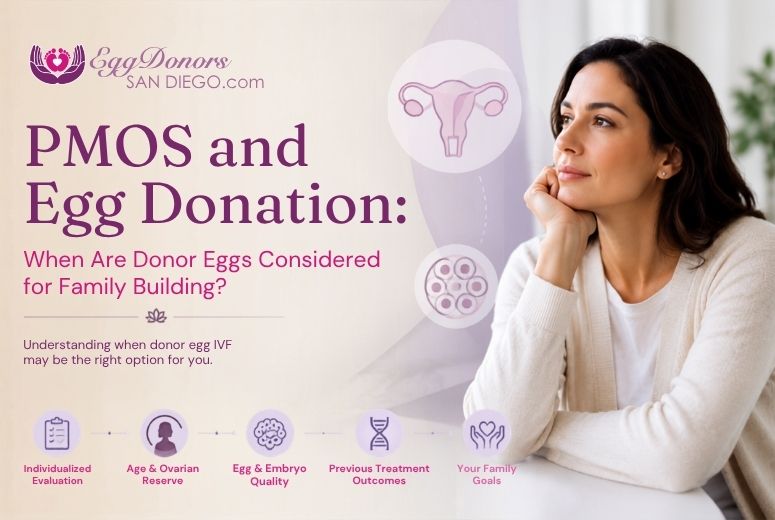
A diagnosis of polycystic ovary syndrome, now called Polyendocrine Metabolic Ovarian Syndrome (PMOS), can raise many questions about fertility. For intended parents who have already experienced unsuccessful treatment, one question may eventually become especially important: When should I consider donor eggs?
The answer requires an important distinction. Having PMOS does not automatically mean you need donor eggs.
Many women with PMOS can become pregnant using their own eggs, either without fertility treatment or with treatments that address ovulatory dysfunction. For others, additional fertility factors such as maternal age, diminished ovarian reserve, egg quality or repeated unsuccessful IVF cycles may eventually make donor egg IVF worth discussing.
“A diagnosis should never determine a fertility treatment plan by itself. We look at the whole patient, including age, ovarian reserve, previous treatment response and reproductive goals, before discussing whether donor eggs may be appropriate.”
Dr. Minoos Hosseinzadeh
What Is PMOS, Formerly Known as PCOS?
In 2026, the American Society for Reproductive Medicine endorsed changing the name Polycystic Ovary Syndrome (PCOS) to Polyendocrine Metabolic Ovarian Syndrome (PMOS).
The terminology better reflects the condition’s broader endocrine and metabolic characteristics rather than implying that ovarian cysts define the syndrome.
PMOS is a heterogeneous condition that may involve:
- irregular or absent ovulation
- elevated androgen levels or clinical signs of androgen excess
- characteristic ovarian morphology
- metabolic abnormalities
- insulin resistance in some patients
For fertility patients, one of its most consequential manifestations is ovulatory dysfunction. If ovulation occurs irregularly, opportunities for conception can become less predictable.
That does not necessarily mean the ovaries lack eggs.
Do Women With PMOS Need Donor Eggs?
Usually, PMOS alone is not an indication for donor eggs.
Someone can have PMOS and still have a substantial ovarian reserve. Depending on age and other fertility factors, treatment may begin with ovulation induction or progress to IUI or IVF when clinically appropriate.
The question changes when PMOS coexists with other reproductive challenges.
Instead of asking only, “Do women with PCOS need donor eggs?” a more useful question is:
What factors, in addition to PMOS, are affecting my probability of achieving a healthy pregnancy with my own eggs?
This is where individualized fertility evaluation becomes essential.
PMOS and the Path Toward Donor Egg IVF
PMOS diagnosis → Comprehensive fertility evaluation → Treatment with own eggs when appropriate → Review response and embryo development → Reassess age, ovarian reserve and previous outcomes → Consider donor egg IVF when clinically appropriate
Ovarian Reserve and Egg Quality Are Not the Same Thing
This distinction is particularly important when discussing PMOS egg donation.
Ovarian reserve refers primarily to the quantity of eggs remaining and the anticipated ovarian response to stimulation. Egg quality concerns an egg’s reproductive competence, including its ability to fertilize, develop into an embryo and potentially result in a healthy pregnancy.
A patient can therefore have a relatively high follicle count while still facing age-related changes in egg quality.
Age remains one of the most important predictors of reproductive potential. As reproductive age advances, chromosomal abnormalities in eggs become more common. This can contribute to unsuccessful fertilization, impaired embryo development, implantation failure or miscarriage.
Therefore, PCOS and egg quality after 40 require a very different discussion from PMOS in a patient in her twenties or early thirties.
When Are Donor Eggs Recommended for PCOS or Considered for PMOS?
There is no universal number of cycles or single laboratory value that determines when donor eggs should be used.
According to ASRM guidance, circumstances in which donor oocytes may be considered include advanced reproductive age, diminished ovarian reserve, poor oocyte or embryo quality and multiple unsuccessful attempts to conceive through assisted reproductive technology.
For someone with PMOS, the discussion may therefore arise when there is:
- Advanced maternal age, particularly when age-related egg quality has become a major limiting factor
- Diminished ovarian reserve in addition to PMOS
- Poor egg or embryo quality observed during previous IVF treatment
- Repeated IVF failure despite appropriately managed treatment
- Repeated difficulty creating viable embryos
- A genetic consideration for which donor eggs may offer an alternative family-building pathway
The important point is that these factors, rather than the PMOS diagnosis itself, drive the conversation.
“For someone who has been through unsuccessful IVF, discussing donor eggs is not simply about moving to another treatment. It is about understanding why previous cycles did not succeed and whether changing the source of the eggs meaningfully changes the reproductive strategy.”
Dr. Minoos Hosseinzadeh
Can You Use Donor Eggs After Failed IVF With PCOS?
Yes. Egg donation after failed IVF with PCOS may be considered when a detailed review suggests that egg-related factors are contributing substantially to unsuccessful treatment.
Previous cycles can provide valuable diagnostic information.
A reproductive endocrinologist may review the number of follicles recruited, eggs retrieved, mature eggs obtained, fertilization, embryo development, blastocyst formation and other clinical findings.
One unsuccessful IVF cycle does not necessarily establish poor egg quality. Patterns across multiple cycles, however, may help a physician understand whether continuing with the patient’s own eggs remains reasonable or whether IVF with donor eggs should become part of the discussion.
Does Age Matter When Considering Donor Eggs With PMOS?
Yes, considerably.
PMOS does not prevent reproductive aging.
A patient may have numerous follicles because of PMOS while simultaneously experiencing age-related changes in oocyte competence. This is why ovarian reserve testing should not be interpreted as a direct measurement of egg quality.
A high AMH level, for example, does not make a 42-year-old patient’s eggs biologically equivalent to those of a much younger person.
When evaluating donor eggs for poor egg quality, chronological age, previous embryo development and treatment history often provide critical context alongside ovarian reserve testing.
Egg Quantity ≠ Egg Quality
Ovarian reserve: Primarily tells us about egg quantity and anticipated response to stimulation.
Egg quality: Relates to reproductive competence and is strongly influenced by age.
Clinical decision: Requires both factors plus previous fertility history.
How Does Donor Egg IVF Work for Someone With PMOS?
Once donor eggs are selected as an appropriate family-building option, treatment shifts from stimulating the intended mother’s ovaries to creating embryos using eggs from a screened donor.
At Egg Donors San Diego, the in-house program specializes in fresh donor cycles coordinated with the associated fertility practice, Fertility Institute of San Diego.
A typical fresh donor IVF pathway may include:
- Consultation and fertility evaluation to establish whether donor egg IVF is appropriate.
- Egg donor matching based on the intended parents’ preferences and available donor characteristics.
- Medical, genetic, psychological and other required screening of the donor.
- Cycle coordination and ovarian stimulation for the selected donor.
- Egg retrieval and fertilization using sperm from the intended parent or donor sperm, depending on the family-building plan.
- Embryo culture under laboratory observation.
- Embryo cryopreservation when appropriate.
- Frozen embryo transfer after preparation of the intended mother’s uterus or transfer to a gestational carrier when applicable.
Why Consider a Fresh Egg Donor Program in San Diego?
For intended parents who decide to pursue donor egg IVF in California, the structure of the donor program can be as important as finding a donor.
EggDonorsSanDiego.com is an in-house fresh egg donor program in San Diego, founded by Dr. Minoos Hosseinzadeh, Founder and Medical Director of Fertility Institute of San Diego.
Rather than separating donor selection, fertility treatment and clinical oversight among unrelated organizations, the program is designed around coordinated care.
This includes:
- an in-house egg donor program
- fresh donor cycles
- individualized donor matching
- coordinated treatment planning
- physician oversight through Fertility Institute of San Diego
- one-on-one fertility care with Dr. Hosseinzadeh from consultation through treatment
For intended parents who have already experienced unsuccessful IVF, that continuity can make a complex next chapter feel more comprehensible and deliberately planned.
Frequently Asked Questions About PMOS and Egg Donation
Can you get pregnant with your own eggs if you have PMOS?
Yes. Many women with PMOS conceive using their own eggs. Treatment depends on age, ovulation, ovarian reserve, sperm factors, reproductive history and other individual circumstances.
Do women with PMOS need donor eggs?
Not simply because they have PMOS. Donor eggs may be considered when other factors such as advanced reproductive age, diminished ovarian reserve, poor egg or embryo quality or previous unsuccessful ART treatment affect the prognosis.
Does PMOS affect egg quality?
PMOS and egg quality have a complex relationship, and PMOS should not automatically be equated with poor-quality eggs. Age remains particularly important when assessing egg-related reproductive potential.
Can I use donor eggs after multiple failed IVF cycles?
Potentially. Multiple failed IVF cycles are among the circumstances in which ASRM identifies donor oocytes as a possible option. A physician should first review the previous cycles to determine what may have contributed to the outcomes.
Does having PMOS affect donor egg IVF?
Having PMOS does not automatically prevent someone from pursuing donor egg IVF. The intended mother’s overall health, uterine factors, metabolic health and pregnancy-related considerations should still be evaluated individually.
When should I consider donor eggs?
A donor egg consultation may be appropriate when age, ovarian reserve, repeated poor embryo development, egg quality concerns or multiple unsuccessful fertility treatments suggest that continuing to use your own eggs may offer a lower probability of success.
Moving Forward After Unsuccessful Fertility Treatment
For someone who has spent months or years pursuing pregnancy, considering PCOS donor eggs can carry emotional weight. It represents more than a change in medical protocol. It can mean reconsidering how you imagined your path to parenthood.
That decision deserves individualized counseling rather than assumptions based on a PMOS diagnosis.
At Egg Donors San Diego and Fertility Institute of San Diego, intended parents can explore whether continuing treatment with their own eggs or transitioning to donor egg IVF is appropriate for their individual circumstances, with personalized guidance from Dr. Minoos Hosseinzadeh.
If you’re ready to start your egg donation journey, click here.
Have a question before scheduling? Use our website chat to ask about the fresh donor program, donor matching or the next steps in your family-building journey.