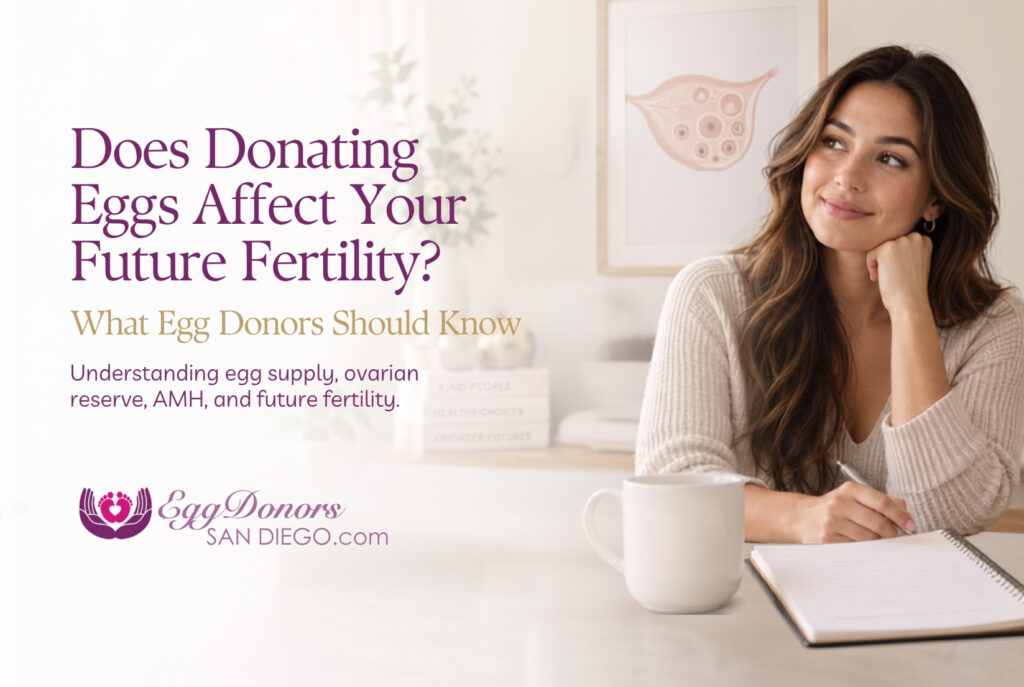
If you are considering becoming an egg donor, you may be excited about helping another person build a family while still having an important question about your own future:
Does egg donation affect fertility?
It is a reasonable question. Egg donation involves fertility medications, ovarian stimulation and an egg retrieval procedure. Understanding what actually happens to your ovaries, egg supply and menstrual cycle can make the decision feel far less uncertain.
Current evidence has not established that appropriately performed egg donation causes infertility or accelerates reproductive aging. However, egg donation is still a medical procedure with recognized short-term risks, and research following egg donors for many years remains more limited than research involving routine IVF patients.
At Egg Donors San Diego, our approach is therefore not to tell prospective donors that there is “nothing to worry about.” Instead, we believe donors deserve accurate information, careful screening, individualized monitoring and physician-led care.
“An egg donor’s future reproductive health is an important part of the conversation. Our responsibility is not simply to retrieve eggs. It is to carefully evaluate, monitor and care for the donor throughout the entire process.”
Dr. Minoos Hosseinzadeh, Founder and Medical Director of Fertility Institute of San Diego and Founder of Egg Donors San Diego
How Does Your Egg Supply Normally Work?
A woman is born with a finite number of immature eggs contained within ovarian follicles. This ovarian reserve gradually declines throughout reproductive life.
During each menstrual cycle, however, the body does not ordinarily select just one follicle from the beginning. A cohort of follicles begins developing. Typically, one becomes the dominant follicle and releases an egg during ovulation. Most of the other recruited follicles undergo a natural process called atresia and do not ovulate.
This distinction is important when discussing egg donor fertility.
Does Egg Donation Use Up Your Future Eggs?
One of the most common concerns prospective donors have is:
“If 15 eggs are retrieved, have I permanently lost 15 eggs that I could have used for my own pregnancies?”
Not exactly.
During ovarian stimulation, fertility medications encourage multiple follicles from the recruited cohort to continue developing rather than allowing only one follicle to become dominant.
The goal is to mature multiple eggs during that particular stimulation cycle.
This is why saying that egg donation simply “takes eggs you would have lost anyway” is an oversimplification. Ovarian physiology is more complex. A more accurate explanation is that stimulation modifies the development of follicles recruited during that cycle.
Available evidence has not demonstrated that this process causes donors to exhaust their ovarian reserve substantially faster.
What Happens During a Natural Cycle vs. an Egg Donation Cycle
Natural cycle:
Multiple follicles recruited → usually one dominant follicle → one egg ovulates → remaining follicles undergo atresia
Donation cycle:
Multiple follicles recruited → ovarian stimulation supports development of multiple follicles → several mature eggs may be retrieved
Does Egg Donation Lower Ovarian Reserve or AMH?
Ovarian reserve refers broadly to the remaining quantity of eggs within the ovaries. Physicians may evaluate it using tools such as:
- Anti-Müllerian hormone, or AMH
- Antral follicle count, or AFC
- Ultrasound assessment of the ovaries
- Other clinical and hormonal information
Research specifically following egg donors remains limited. The American Society for Reproductive Medicine notes that available evidence does not suggest egg donation is associated with changes in ovarian reserve, while also acknowledging that long-term data, particularly for repeat donors, are limited.
That distinction matters.
We cannot responsibly promise that egg donation could never affect a person’s future fertility. What can be said is that current evidence has not established egg donation as a cause of infertility or accelerated depletion of ovarian reserve.
Can Egg Donors Have Children Later?
Yes. Previous egg donation does not mean that you cannot become pregnant or have children later.
Future fertility is influenced by many variables unrelated to donation, including:
- Age
- Genetics
- Ovarian reserve
- Endometriosis
- Fallopian tube health
- Uterine conditions
- Partner-related fertility factors
- Lifestyle and general reproductive health
Age remains particularly important because both egg quantity and egg quality naturally change over time.
A former donor who experiences difficulty becoming pregnant years later should therefore receive the same individualized fertility evaluation that would be appropriate for anyone experiencing difficulty conceiving.
What Happens to Your Ovaries After Egg Retrieval?
Egg retrieval is generally a short procedure, but your ovaries do not immediately return to their baseline state the moment the procedure ends.
Because multiple follicles have developed, the ovaries may temporarily remain enlarged. Some donors experience bloating, pelvic pressure, cramping, fatigue or spotting during recovery.
Your clinical team should explain which symptoms are expected and which require immediate attention.
Most donors should also expect their menstrual cycle to resume after retrieval, although the exact timing can vary.
Donor Recovery Timeline
Egg retrieval → short-term bloating/cramping may occur → ovaries gradually return toward baseline → next menstrual period occurs → normal cycles generally resume
What Are the Risks of Egg Donation?
Egg donor safety requires acknowledging risks rather than minimizing them.
Ovarian stimulation can cause side effects such as headaches, bloating, mood changes, breast tenderness and pelvic discomfort. A more significant complication is ovarian hyperstimulation syndrome (OHSS).
Egg retrieval also carries small procedural risks, including bleeding, infection and ovarian torsion.
The American Society for Reproductive Medicine has reported severe OHSS at approximately 1 to 2 percent per retrieval cycle in the literature considered by its committee, while serious acute procedural complications such as pelvic infection, intraperitoneal hemorrhage or ovarian torsion were estimated at less than 0.5 percent.
Modern stimulation protocols and individualized medical management can help reduce certain risks, but no medical procedure should be described as completely risk-free.
Can Egg Donation Cause Early Menopause?
There is currently no established evidence showing that appropriately performed egg donation causes early menopause.
Menopause occurs after progressive depletion and aging of the ovarian follicle pool over many years. Because ovarian stimulation acts primarily upon follicles participating in that cycle’s recruitment process, current evidence has not demonstrated that donation meaningfully accelerates this process.
However, long-term donor research remains incomplete. This is one reason responsible programs should avoid making absolute guarantees about egg donation future fertility.
Why Screening and Monitoring Matter
Egg donation safety starts before fertility medication is prescribed.
At Egg Donors San Diego, our physician-led, in-house egg donor program is designed around careful donor evaluation and ongoing clinical oversight.
Depending on the donor and clinical circumstances, the process can include medical history review, physical evaluation, ovarian reserve assessment, genetic and infectious disease screening, ultrasound evaluation and hormone testing.
Once stimulation begins, ultrasound and hormonal monitoring help the physician evaluate how the ovaries are responding and determine whether medication adjustments are appropriate.
“Every donor responds differently to ovarian stimulation. Individualized monitoring allows us to evaluate that response throughout the cycle rather than treating every donor according to exactly the same protocol.”
Dr. Minoos Hosseinzadeh
Federal regulations also establish donor screening and testing requirements for reproductive tissue donors, including testing for relevant communicable diseases.
Your Reproductive Health Throughout Egg Donation
Medical screening → ovarian reserve assessment → individualized stimulation → ultrasound and hormone monitoring → physician-performed retrieval → recovery guidance and follow-up
How Many Times Can You Safely Donate Eggs?
Repeated donation deserves additional consideration because each stimulation and retrieval represents another exposure to procedural risk.
The American Society for Reproductive Medicine currently supports limiting an individual egg donor to no more than six stimulated donation cycles, based primarily on potential cumulative health risks and the limitations of long-term evidence.
This does not mean that six cycles are automatically appropriate for every donor. Previous response, medical history and individual circumstances should be evaluated before another donation.
Can You Freeze Your Own Eggs After Being an Egg Donor?
Being a previous egg donor does not automatically prevent you from freezing your own eggs later.
If you eventually consider fertility preservation, your reproductive endocrinologist can evaluate your age, AMH, antral follicle count and other reproductive factors at that time.
Importantly, egg freezing cannot guarantee a future baby. Decisions about your own family planning should therefore be made independently of the fact that you previously donated eggs.
Questions Every Prospective Donor Should Feel Comfortable Asking
Before participating in an egg donor program, ask who will manage your stimulation, how your ovarian response will be monitored, what happens if you respond too strongly to medication, who performs retrieval, what complications require urgent attention and what follow-up is available afterward.
A responsible program should welcome these questions.
At Egg Donors San Diego, donors participate through an in-house program founded by Dr. Minoos Hosseinzadeh, a reproductive endocrinologist and the Founder and Medical Director of Fertility Institute of San Diego. The objective is not simply a successful retrieval. It is a medically supervised donation experience in which the donor’s reproductive health remains part of the clinical decision-making process.
Frequently Asked Questions
Can donating eggs make you infertile?
Current evidence has not established appropriately performed egg donation as a cause of infertility. However, long-term research on donors is limited, and donation involves recognized medical and procedural risks.
Does donating eggs reduce your egg supply?
Ovarian stimulation encourages multiple follicles recruited during that cycle to mature. Available evidence has not demonstrated that egg donation significantly accelerates depletion of ovarian reserve.
Does egg donation lower AMH?
Available evidence has not established a persistent reduction in ovarian reserve from egg donation, including based on AMH data, but long-term evidence remains limited.
Can you get pregnant after donating eggs?
Yes. Previous egg donation does not prevent someone from becoming pregnant later. Future fertility still depends on age, reproductive health and numerous other factors.
Does egg donation cause early menopause?
Current evidence has not established egg donation as a cause of early menopause.
Does your menstrual cycle return to normal after egg donation?
For most donors, menstruation resumes following retrieval and cycles subsequently return to their usual pattern. Your clinical team can advise you about what to expect based on your individual cycle.
Are there long-term fertility risks of egg donation?
No definitive long-term fertility harm has been established, but long-term donor follow-up data remain limited. Prospective donors should receive transparent counseling about both known risks and areas where evidence is incomplete.
Where can I become an egg donor in San Diego?
Egg Donors San Diego offers a physician-led, in-house egg donor program in San Diego, California. Prospective donors undergo eligibility screening before entering the donation process.
Your Future Fertility Deserves the Same Attention as Your Donation
Egg donation can be an extraordinary contribution to another person’s path to parenthood. Choosing to donate should never require ignoring questions about your own reproductive future.
Current evidence is reassuring: egg donation has not been established as a cause of infertility, premature reproductive aging or significant loss of ovarian reserve. At the same time, responsible donor care means acknowledging that ovarian stimulation and egg retrieval have risks and that long-term research involving donors is still developing.
The right program should help you understand both.
If you’re ready to start your egg donation journey, click here.