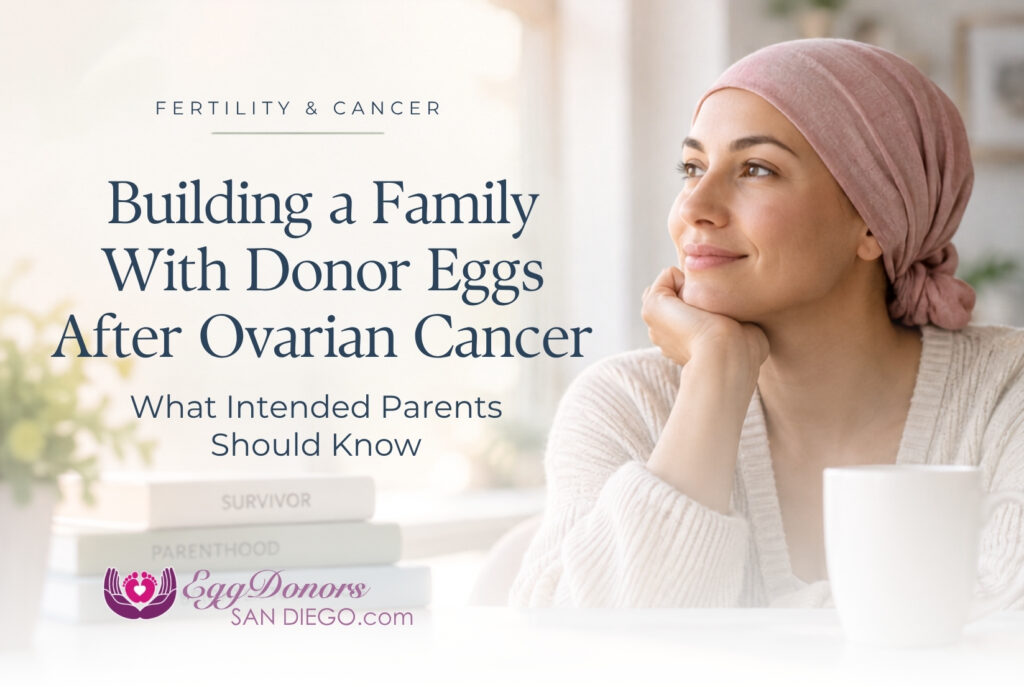
An ovarian cancer diagnosis can alter the path to parenthood, but it does not necessarily close it.
For some survivors, ovarian function remains sufficient after treatment to consider pregnancy using their own eggs. For others, surgery, chemotherapy, radiation, age-related changes, or diminished ovarian reserve may make this difficult or impossible. In these circumstances, donor eggs after ovarian cancer may provide another pathway toward building a family.
The important distinction is that there is no single fertility outcome after ovarian cancer. The appropriate path depends on the cancer diagnosis, treatment received, reproductive anatomy, ovarian reserve, overall health, and medical clearance from the appropriate specialists.
Post-Cancer Family Building Pathway
From survivorship to a brighter tomorrow: a personalized approach to help you explore your family-building options after ovarian cancer.
- Ovarian Cancer Treatment: Surgery, chemotherapy, radiation, or other therapies may affect reproductive function.
- Post-Treatment Medical & Fertility Assessment: A thorough evaluation of your medical history, treatment, and overall health.
- Evaluate Ovarian Function & Reproductive Anatomy: Assess ovarian reserve, hormonal function, and remaining reproductive organs.
- Can Using Your Own Eggs Still Be Considered?: Determine whether your own eggs remain an option based on testing and your medical history.
- Consider Donor Eggs When Appropriate: If using your own eggs is not possible or is unlikely to be successful, donor eggs may be discussed.
- Medical Clearance for Pregnancy: Coordinate with your oncology and fertility team to ensure it is safe to move forward.
- Donor Selection & IVF: Choose an egg donor, complete medical and genetic screening, and create embryos through IVF.
- Embryo Transfer or Gestational Carrier When Appropriate: Transfer embryos to your uterus if medically appropriate, or consider a gestational carrier.
Every post-cancer fertility journey is individualized. Treatment options depend on cancer history, prior treatment, reproductive function, and medical clearance.
At Egg Donors San Diego, our focus is on helping intended parents understand what happens when donor egg IVF becomes an appropriate part of that pathway.
How Can Ovarian Cancer Treatment Affect Fertility?
The reproductive impact of ovarian cancer varies considerably.
Surgery may involve removing one ovary, both ovaries, the fallopian tubes, the uterus, or other reproductive structures depending on the type, location, and extent of disease. In selected early-stage cancers, fertility-sparing surgery may sometimes be possible.
Chemotherapy can also affect ovarian follicles and may contribute to diminished ovarian reserve or primary ovarian insufficiency. Pelvic radiation can affect ovarian function and, depending on the treatment field and dose, may also affect the uterus.
This is why fertility after cancer should be evaluated individually rather than assumed based on diagnosis alone.
A post-treatment fertility assessment may consider:
- The type and stage of ovarian cancer
- Previous surgery and remaining reproductive anatomy
- Chemotherapy or radiation exposure
- Menstrual and hormonal function
- Ovarian reserve, when ovaries remain
- Previously frozen eggs or embryos
- Age and broader reproductive history
- Oncology recommendations regarding pregnancy
Some survivors may still be candidates to use their own eggs. Others may discover that IVF with donor eggs after cancer treatment offers a more appropriate route.
“A history of ovarian cancer does not give us one universal fertility answer. We first need to understand what treatment the patient received, what reproductive function remains, and whether pregnancy is medically appropriate. Only then can we determine which family-building options should be considered.”
Dr. Minoos Hosseinzadeh, Founder and Medical Director, Fertility Institute of San Diego
When Are Donor Eggs Considered After Ovarian Cancer?
Donor eggs after ovarian cancer may be considered when an intended parent cannot produce viable eggs, has had both ovaries removed, experiences primary ovarian insufficiency, or has significantly compromised ovarian reserve following treatment.
For example, when both ovaries have been surgically removed, the body can no longer produce eggs. If the uterus remains and pregnancy is medically appropriate, donor eggs or previously preserved eggs may potentially be used to create embryos.
Donor eggs may also be discussed when ovarian function remains but the likelihood of obtaining viable eggs is considered very low.
Importantly, choosing egg donation after cancer is not automatically the next step for every survivor. A reproductive endocrinologist should evaluate whether using the intended parent’s own eggs remains reasonable before donor egg treatment is considered.
Can You Carry a Pregnancy After Ovarian Cancer?
This is one of the most important questions because egg source and the ability to carry a pregnancy are separate medical considerations.
A survivor may be unable to use her own eggs yet retain a uterus capable of carrying a pregnancy. In this situation, donor egg IVF may involve creating embryos with donor eggs followed by embryo transfer to the intended parent’s uterus, provided she receives appropriate medical clearance.
For another survivor, previous surgery may have included removal of the uterus. Certain cancer treatments or other medical factors may also make carrying a pregnancy inadvisable.
When carrying a pregnancy is not possible or medically recommended against, embryos created using donor eggs can potentially be transferred to a gestational carrier.
The decision requires coordination between reproductive medicine and the patient’s oncology and other relevant medical teams. Cancer survivorship should never be treated as a generic IVF scenario.
Two Different Questions
Do I need donor eggs?
This relates primarily to egg availability, ovarian function, reproductive potential, and previous fertility preservation.
Can I safely carry a pregnancy?
This relates to the uterus, previous treatment, current health, cancer history, and medical clearance.
One answer does not automatically determine the other.
How Does Donor Egg IVF Work After Cancer?
Once donor egg IVF for ovarian cancer survivors has been determined to be an appropriate option, treatment shifts from assessing fertility potential to carefully coordinating donor selection and embryo creation.
At Egg Donors San Diego, intended parents have access to an in-house fresh egg donor program in San Diego, with treatment coordinated through Fertility Institute of San Diego.
A fresh donor cycle generally involves:
- Consultation and individualized treatment planning with Dr. Minoos Hosseinzadeh.
- Medical clearance and reproductive assessment for the intended parent.
- Selecting an egg donor from the in-house donor program.
- Medical and genetic screening and completion of required clearances.
- Donor ovarian stimulation with individualized monitoring.
- Egg retrieval and fertilization using the intended parent’s partner’s sperm or donor sperm.
- Embryo culture and cryopreservation.
- Frozen embryo transfer to the intended parent or gestational carrier when appropriate.
This approach allows the fresh donor cycle to be planned specifically for the intended parents rather than beginning with a predetermined cohort of previously frozen donor eggs.
Choosing an Egg Donor After Cancer Treatment
After navigating cancer treatment, choosing an egg donor can bring a very different set of emotions and decisions.
Intended parents may consider physical characteristics, ancestry, educational and personal background, family medical history, genetic screening, and other attributes when exploring donor profiles.
Medical screening is equally important. An established egg donor program in California should have a defined process for evaluating donor health and suitability before treatment proceeds.
For cancer survivors in particular, continuity can also matter. Instead of navigating disconnected providers, Egg Donors San Diego and Fertility Institute of San Diego provide an integrated setting in which Dr. Hosseinzadeh oversees the fertility treatment process from consultation through treatment planning.
“For many intended parents after cancer, the goal is not simply to find an egg donor. It is to build a thoughtful treatment plan around their medical history, family-building goals, and the pathway that is appropriate for them now.”
Dr. Minoos Hosseinzadeh
What Should You Discuss Before Starting Donor Egg IVF?
Before beginning donor egg IVF in California, your consultation should establish a clear picture of both your oncologic history and reproductive goals.
Bring relevant oncology records, surgical reports, treatment summaries, information about previously preserved eggs or embryos, and any recommendations your oncology team has provided regarding future pregnancy.
Useful questions include:
- Do I still have the potential to use my own eggs?
- Do I need additional ovarian reserve testing?
- Is my uterus able to carry a pregnancy?
- What medical clearance is needed before treatment?
- When is it appropriate for me to attempt pregnancy?
- How does a fresh donor egg cycle work?
- What screening is performed for egg donors?
- Could embryos be created for use with a gestational carrier if necessary?
There may not be one answer that applies to every survivor. The objective is to identify the safest and most appropriate reproductive pathway for the individual.
Frequently Asked Questions
Can I have a baby after ovarian cancer?
Potentially, yes. Family-building options depend on your treatment, remaining reproductive anatomy, ovarian function, medical history, and whether you are cleared to carry a pregnancy.
Can ovarian cancer survivors use donor eggs?
Yes. Donor eggs after ovarian cancer may be an option when using the survivor’s own eggs is not possible or is unlikely to be successful. Individual medical assessment is essential.
What if both ovaries were removed?
If both ovaries were removed, new eggs can no longer be produced. Donor eggs or eggs previously frozen before treatment may potentially be used for IVF.
Can I carry a donor egg pregnancy if I still have my uterus?
Possibly. Having a uterus does not by itself establish that pregnancy is medically advisable. Your reproductive endocrinologist and relevant medical specialists should determine whether you are medically cleared to carry.
Can donor eggs be used with a gestational carrier?
Yes. Embryos created with donor eggs can potentially be transferred to a gestational carrier when the intended parent cannot or should not carry the pregnancy.
Where can I find a fresh egg donor program in San Diego?
Egg Donors San Diego offers an in-house fresh egg donor program coordinated with Fertility Institute of San Diego and Dr. Minoos Hosseinzadeh.
A New Path Toward Parenthood
Cancer treatment may change how a family is built, but the conversation about parenthood does not necessarily end when treatment does.
For some ovarian cancer survivors, fertility assessment may show that using their own eggs remains possible. For others, donor eggs after ovarian cancer can create a new reproductive pathway. And when carrying a pregnancy is not medically appropriate, donor eggs may also be incorporated into IVF with a gestational carrier.
The first step is not assuming which option you need. It is understanding what is medically possible now.
At Egg Donors San Diego, intended parents receive individualized guidance through an in-house donor program and fertility treatment coordinated by Dr. Minoos Hosseinzadeh at Fertility Institute of San Diego.
If you’re ready to start your egg donation journey, click here.