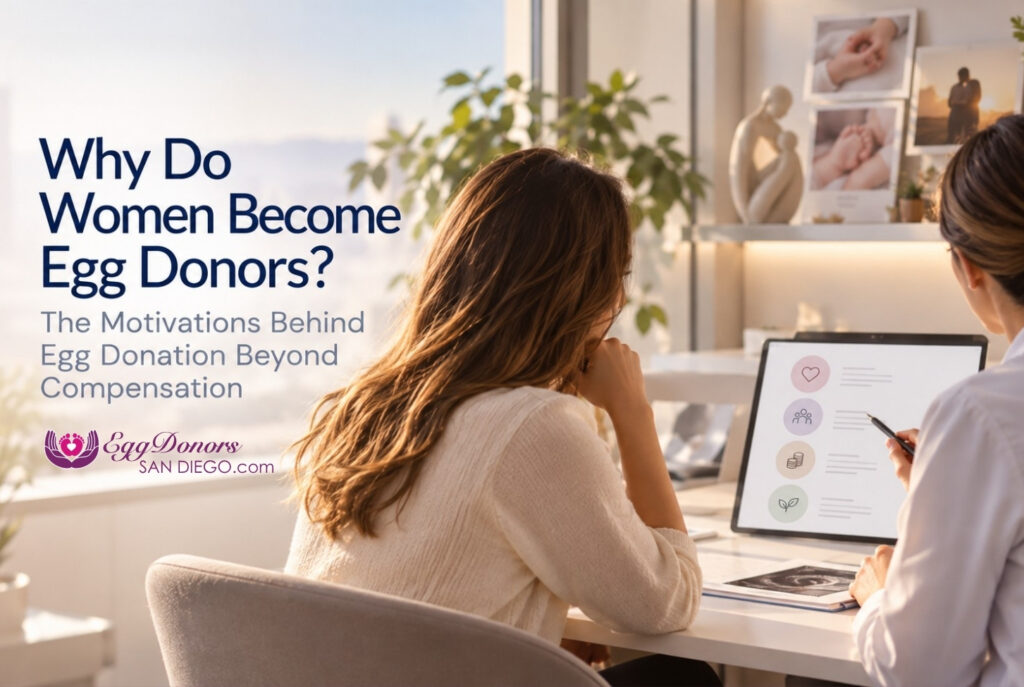
Why do women become egg donors? There is no single answer.
For some women, the opportunity to help another person or couple pursue parenthood is deeply meaningful. Others have seen infertility affect someone close to them and understand how difficult family building can be. Financial compensation may also be a consideration. Often, egg donor motivation reflects several of these factors at the same time.
At EggDonorsSanDiego.com, we believe prospective donors deserve an honest picture of both sides of the decision. Egg donation can be meaningful, but it also requires medical screening, fertility medications, monitoring appointments, an egg retrieval procedure, recovery time, and thoughtful consideration of the long-term implications of donation.
“Women come to egg donation with different experiences, priorities, and motivations. What matters is that each prospective donor understands the process and makes an informed decision that feels right for her,”
Dr. Minoos Hosseinzadeh
There Is No Single Reason Women Become Egg Donors
When people ask why women donate eggs, compensation is often the first explanation that comes to mind. Compensation is certainly relevant, but it does not tell the entire story.
The reasons women choose egg donation can be personal, practical, emotional, or a combination of all three.
A prospective donor may be motivated by:
- Helping intended parents pursue family building
- Personal exposure to infertility
- A desire to make a meaningful contribution to another family
- Curiosity about the egg donation experience
- Financial compensation for the time and commitment involved
- Several motivations occurring simultaneously
None of these motivations needs to exist in isolation.
The more important question may therefore be not simply, “Why should I become an egg donor?” but, “Do I understand what becoming an egg donor involves, and is this decision appropriate for me?”
Helping Someone Pursue Parenthood
One of the most frequently discussed emotional reasons for becoming an egg donor is the possibility of helping another person build a family.
People pursue donor eggs for many different reasons. Some intended parents may be experiencing infertility or age-related reproductive changes. Others may be building their families as same-sex couples or single parents. There are also circumstances in which someone cannot use their own eggs for medical or genetic reasons.
For a donor, knowing that her participation may contribute to another person’s family-building journey can be meaningful.
“Egg donation brings together two very different experiences: the donor’s medical journey and the intended parent’s path toward building a family. Both deserve individualized care and respect,”
Dr. Minoos Hosseinzadeh
Importantly, wanting to help someone does not mean a donor should overlook her own questions, boundaries, or concerns. Altruism and careful decision-making can coexist.
Personal Experiences With Infertility Can Shape Egg Donor Motivation
Sometimes the answer to why do people donate their eggs begins with an experience outside the donor’s own reproductive life.
A prospective donor may have watched a sister, friend, relative, or colleague experience infertility. Seeing someone undergo fertility treatment can make the challenges of family building more tangible.
That experience may lead a woman to consider whether egg donation is something she would be comfortable pursuing.
However, a personal connection to infertility should not create a sense of obligation. Egg donation remains an individual medical decision requiring informed consent.
Compensation Matters, But So Does Informed Choice
Do egg donors get paid? Egg donors who participate in the program receive compensation for the time, commitment, inconvenience, and responsibilities involved in the donation process.
Transparency about egg donor compensation is important. Compensation recognizes the donor’s participation in a process that involves appointments, medications, monitoring, scheduling commitments, egg retrieval, and recovery.
It should not, however, replace understanding of what participation entails.
Before deciding whether to become an egg donor in San Diego, a prospective donor should understand that the process includes::
- Medical, genetic, and psychological screening
- Fertility medications and self-administered injections
- Regular monitoring appointments
- Temporary lifestyle and activity restrictions
- Ovarian stimulation
- Egg retrieval
- Possible medication and procedural side effects
- Recovery following retrieval
- Emotional and long-term considerations related to donation
Compensation can be one legitimate factor in the decision. The goal is not to pretend that money is irrelevant. Instead, compensation should be considered alongside the medical, personal, and practical responsibilities of becoming an egg donor.
Good Reasons to Donate Are Also Good Reasons to Ask Questions
Someone can genuinely want to help a family and still have questions about egg donor safety, medications, privacy, recovery, future fertility, compensation, or donor-conceived children.
Those questions are appropriate and can be an important part of making an informed decision.
Before applying, consider asking yourself:
- Am I comfortable taking fertility medications and giving injections?
- Can I attend the necessary monitoring appointments?
- Do I understand the egg retrieval procedure and its potential risks?
- How do I feel about the potential long-term implications of having a genetic connection to a donor-conceived person?
- Have I considered privacy and future contact implications?
- Am I comfortable with the time commitment and temporary restrictions?
- Do I understand how compensation works?
- Have I had an opportunity to ask medical questions without feeling pressured?
Understanding the potential risks is particularly important. Fertility medications can cause temporary symptoms such as bloating, pelvic discomfort, mood changes, and headaches. More significant complications, including ovarian hyperstimulation syndrome, bleeding, infection, or complications associated with a procedure or anesthesia, are possible and should be discussed with the treating physician.
Questions about whether donating eggs affects future fertility also deserve a careful, individualized medical discussion rather than assumptions or guarantees.
What Does the Egg Donation Process Involve?
Although each donor’s experience can differ, the egg donation process generally progresses through several stages.
The screening process may include a review of personal and family medical history, a physical evaluation, required laboratory and infectious disease testing, genetic screening, and psychoeducational or psychological evaluation, depending on the donor and program requirements.
If approved and matched for a donation cycle, the donor receives instructions about medications and monitoring. During ovarian stimulation, fertility medications encourage multiple follicles to develop. Ultrasound examinations and laboratory testing are used to monitor the ovarian response.
When the follicles are ready, egg retrieval is scheduled. Retrieval is a medical procedure, and donors receive individualized instructions regarding preparation and recovery.
EggDonorsSanDiego.com is an in-house fresh egg donor program in San Diego, providing donors with coordinated screening, individualized guidance, and physician oversight throughout the donation process.
How Do I Know If Egg Donation Is Right for Me?
Researching why become an egg donor is only the beginning.
A good decision should incorporate your health, schedule, personal values, expectations, comfort with the medical process, and understanding of the longer-term implications of donation.
For some women, both the opportunity to help intended parents and the compensation associated with donation factor into their decision. Another woman may research the process carefully and decide that egg donation is not appropriate for her.
Both outcomes can reflect informed decision-making.
“The purpose of screening and education is not simply to determine whether someone qualifies medically. A prospective donor should also have the information she needs to decide whether she is comfortable moving forward,”
Dr. Minoos Hosseinzadeh
Frequently Asked Questions
Why do women become egg donors?
Women consider egg donation for many reasons, including helping intended parents build families, personal exposure to infertility, the desire to make a meaningful contribution, financial compensation, or a combination of motivations.
Is egg donation only about the money?
No. Compensation can be an important and legitimate consideration, but donors may have additional personal or emotional motivations. Prospective donors should understand both the compensation and the medical and personal commitments involved.
Do egg donors get paid in California?
Egg donors who participate in a donor program may receive compensation according to the program’s policies and applicable requirements. Compensation can recognize the time, commitment, inconvenience, and responsibilities associated with the donation process.
Is egg donation emotionally rewarding?
Some donors may find helping intended parents meaningful or emotionally rewarding, while individual experiences vary. Prospective donors should consider their own feelings about donation and its potential long-term implications.
What should I consider before becoming an egg donor?
Consider the screening requirements, fertility medications, injections, monitoring, retrieval procedure, potential risks, recovery, scheduling requirements, compensation, privacy, and your feelings about donor conception and genetic connections.
What are the requirements to donate eggs in San Diego?
Eligibility depends on medical, reproductive, genetic, psychological, and program-specific criteria. Prospective donors complete a screening process to determine whether they meet the requirements for participation.
What are the risks of egg donation?
Egg donation involves fertility medications and a medical retrieval procedure. Potential risks and side effects can include bloating, discomfort, medication-related symptoms, ovarian hyperstimulation syndrome, bleeding, infection, and procedure or anesthesia-related complications. Individual risks should be reviewed with the treating physician before consent.
Becoming an Egg Donor in San Diego
If you are considering whether to become an egg donor in San Diego, start by learning about eligibility, screening, the medical process, potential risks, compensation, and the responsibilities expected throughout a donation cycle.
EggDonorsSanDiego.com is an in-house fresh egg donor program in San Diego, California, founded by Dr. Minoos Hosseinzadeh. Prospective donors receive individualized screening, guidance, and physician oversight as they move through the eligibility and donation process.
You do not need to have only one reason for considering egg donation. You can want to help another family while also considering compensation. You can feel enthusiastic while still having questions. What matters is having enough information to make a voluntary, informed decision.
If you’re ready to start your egg donation journey, click here.