When patients begin researching IVF, they often encounter two terms repeatedly: egg quality and embryo quality. These phrases are frequently used interchangeably online, in forums, and even in casual fertility discussions. However, they are not the same thing.
Understanding the difference between egg quality and embryo quality is one of the most important educational steps for intended parents navigating fertility treatment, donor egg IVF, or repeated IVF failure.
At the heart of IVF success factors lies a more nuanced reality. Egg quality matters significantly, but embryo quality IVF outcomes depend on multiple biological and laboratory variables working together over time.
As Dr. Minoos Hosseinzadeh explains:
“Patients often assume that if an egg is healthy, the embryo will automatically be healthy as well. In reality, embryo development is a dynamic process influenced by both egg and sperm quality, genetics, laboratory conditions, and developmental timing.”
Dr. Minoos Hosseinzadeh
For patients exploring IVF San Diego options, understanding this distinction creates more realistic expectations and more informed decision-making.
What Is Egg Quality?
Egg quality refers to the biological and chromosomal competence of an egg cell before fertilization occurs.
In reproductive medicine, high-quality eggs generally have:
- Proper chromosomal alignment
- Healthy mitochondrial function
- Strong developmental potential
- Appropriate maturation
Egg quality naturally changes with age, particularly after age 35. While ovarian reserve measures the quantity of eggs remaining, it does not necessarily predict the quality of those eggs.
Factors that influence egg quality include:
- Maternal age
- Genetics
- Hormonal health
- Lifestyle factors
- Smoking exposure
- Oxidative stress
- Certain medical conditions
One of the most important concepts patients should understand is this:
➡️ Egg quality is about the starting biological material, not the final embryo itself.
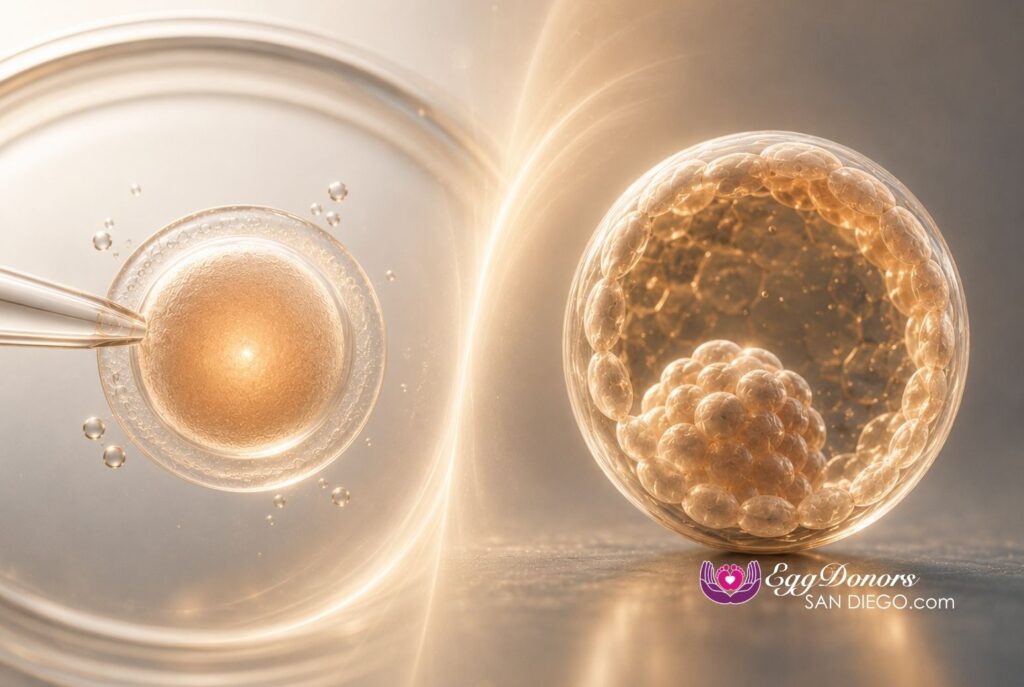
A healthy-looking egg still must fertilize properly, divide correctly, and continue developing through multiple IVF embryo development stages before becoming a viable blastocyst.
Suggested Visual Placement
Infographic: “Egg Quality vs Embryo Quality Explained”
- Left side: Egg maturity and chromosomal health
- Right side: Embryo development timeline after fertilization
What Is Embryo Quality?
Embryo quality IVF assessments occur after fertilization.
Once sperm fertilizes the egg, embryologists begin monitoring how the embryo develops over several days. This developmental process includes:
- Fertilization
- Early cell division
- Cleavage-stage progression
- Morula formation
- Blastocyst development
Embryo quality reflects how successfully a fertilized egg continues developing over time.
This is why embryo quality explained in IVF must involve more than just the egg itself.
Embryologists evaluate:
- Cell symmetry
- Division timing
- Fragmentation levels
- Blastocyst expansion
- Inner cell mass quality
- Trophectoderm structure
Strong blastocyst quality IVF outcomes are often associated with embryos that continue dividing consistently and demonstrate organized cellular architecture.
Why Egg Quality and Embryo Quality Are Not the Same
One of the biggest misconceptions in fertility care is assuming that good eggs always create good embryos.
They do not.
The difference between egg quality and embryo quality becomes clearer when patients understand that embryo development depends on multiple interacting variables.
For example:
- A chromosomally healthy egg may fertilize poorly due to sperm DNA fragmentation
- Embryos may arrest during development despite good ovarian response
- Genetic abnormalities can emerge after fertilization
- Laboratory conditions may influence embryo progression
➡️ Embryo quality is the result of multiple biological variables interacting together.
This explains why some patients retrieve many eggs but develop few blastocysts, while others produce fewer eggs yet achieve strong embryo quality after fertilization.
As Dr. Hosseinzadeh notes:
“IVF is not simply about collecting eggs. It is about how those eggs respond throughout the entire developmental journey.”
Dr. Hosseinzadeh
How Sperm Quality Influences Embryo Development
Modern fertility medicine increasingly recognizes the importance of male fertility in embryo quality IVF outcomes.
Sperm contributes half of the embryo’s genetic material. Even when donor egg IVF is used, sperm quality and embryo development remain closely connected.
Important male fertility factors include:
- Sperm DNA fragmentation
- Morphology
- Motility
- Oxidative stress
- Genetic integrity
Poor sperm quality may contribute to:
- Abnormal fertilization
- Embryo arrest
- Reduced blastocyst progression
- Lower implantation rates
➡️ Donor eggs do not eliminate the importance of male fertility.
This is particularly important for patients who previously assumed egg quality alone determines IVF success factors.
Suggested Visual Placement
Chart: “How Sperm DNA Fragmentation Affects Embryo Development”
- Fertilization rate
- Blastocyst formation
- Implantation potential
How Embryos Develop During IVF
Understanding how embryos develop in IVF helps patients better interpret embryo grading explained during treatment.
Day 1: Fertilization
The egg and sperm combine.
Day 2 to 3: Cleavage Stage
Embryos divide from 2 cells to 4 to 8 cells.
Day 4: Morula
Cells compact into a multicellular structure.
Day 5 to 7: Blastocyst Stage
Fluid fills the embryo cavity, and specialized cell layers form.
Blastocyst development matters because embryos reaching this stage often demonstrate stronger developmental competence.
However, not every embryo that reaches blastocyst stage is genetically normal.
This is why clinics may recommend PGT testing in certain IVF cycles.
What Embryologists Look for When Evaluating Embryos
Embryo grading is a standardized process used to assess developmental appearance.
Embryologists examine:
- Expansion level
- Cell cohesiveness
- Fragmentation percentage
- Inner cell mass quality
- Trophectoderm appearance
The inner cell mass eventually forms the fetus, while the trophectoderm contributes to placental development.
Good embryo quality IVF assessments generally involve:
- Organized cell structure
- Consistent development
- Minimal fragmentation
- Strong blastocyst expansion
Still, embryo grading explained properly requires an important caveat:
Morphology alone cannot predict implantation with certainty.
The Limits of Traditional Embryo Grading
Traditional embryo grading relies heavily on periodic visual observations.
This creates several limitations:
- Evaluations occur at selected time points
- Development between observations may be missed
- Human interpretation introduces variability
- Static snapshots cannot fully capture developmental dynamics
➡️ Traditional grading does not capture continuous embryo development.
Two embryos with similar appearance may behave very differently over time.
This limitation has driven increased interest in precision IVF technologies.
How AI-Assisted Embryo Selection Changes IVF Evaluation
Advanced fertility clinics increasingly use time-lapse imaging and AI-assisted embryo selection systems to gather more continuous developmental data.
These technologies monitor embryos throughout development without repeatedly removing them from incubators.
Benefits may include:
- Continuous developmental monitoring
- Morphokinetic analysis
- More objective embryo prioritization
- Additional developmental insight
➡️ AI-assisted systems help embryologists make more objective, data-informed decisions.
Suggested Visual Placement
Timeline Graphic: “Traditional Grading vs AI-Assisted Embryo Monitoring”
Precision IVF at Fertility Institute of San Diego
Fertility Institute of San Diego is currently the only clinic in San Diego that includes AI-assisted EmbryoScope technology with Chloe AI as part of every IVF cycle.
This precision IVF approach provides continuous embryo monitoring and supports more informed embryo prioritization decisions.
This technology may be particularly valuable for:
- Donor egg IVF patients
- Patients over 35
- Repeated IVF failure cases
- Limited embryo cases
According to Dr. Hosseinzadeh:
“AI-assisted embryo assessment does not replace embryologists. It enhances the amount of developmental information available when making critical embryo selection decisions.”
Dr. Hosseinzadeh
Why Donor Eggs Improve Outcomes for Some Patients
For some patients, donor egg IVF significantly improves outcomes because younger donor eggs often have higher chromosomal normality rates.
Benefits may include:
- Improved fertilization potential
- Higher blastocyst development rates
- Better implantation probability
- Lower chromosomal abnormality risk
Still, donor egg embryo quality outcomes remain influenced by:
- Sperm quality
- Embryo genetics
- Laboratory conditions
- Uterine receptivity
➡️ Donor eggs improve one major variable, but embryo development still depends on multiple factors.
IVF Success Depends on More Than One Variable
Patients often search for what affects IVF success most, hoping for a single answer.
In reality, IVF success factors are multifactorial.
Successful outcomes may depend on:
- Egg quality
- Sperm quality
- Embryo quality
- Laboratory environment
- Embryologist expertise
- Uterine health
- Treatment protocol
- Embryo implantation conditions
Fertility care works best when patients understand IVF as a biologically interconnected process rather than a single-variable equation.
Understanding the Difference Creates Better Expectations
Understanding egg quality vs embryo quality helps reduce confusion and anxiety during fertility treatment.
It also helps patients approach IVF with a more informed, science-based perspective.
Egg quality matters.
Embryo quality matters.
Sperm quality matters.
But no single factor alone determines IVF success.
For many intended parents, clarity creates confidence, especially when working with a personalized fertility clinic San Diego patients can trust for individualized care and precision-focused treatment strategies.
If you’re ready to start your egg donation journey, click here.
FAQ
What is the difference between egg quality and embryo quality?
Egg quality refers to the health and developmental potential of the egg before fertilization. Embryo quality reflects how the fertilized egg develops afterward.
Does egg quality determine embryo quality?
Egg quality strongly influences embryo development, but sperm quality, genetics, and laboratory conditions also affect embryo quality IVF outcomes.
Can poor sperm quality affect embryos?
Yes. Sperm DNA fragmentation and other male fertility issues can negatively impact fertilization, blastocyst development, and embryo implantation.
What determines embryo quality in IVF?
Embryo quality depends on egg quality, sperm quality, chromosomal integrity, embryo development timing, and laboratory conditions.
Do donor eggs improve embryo quality?
Younger donor eggs may improve embryo development potential, but embryo quality after fertilization still depends on multiple biological variables.
What is embryo grading?
Embryo grading is the process embryologists use to evaluate embryo appearance, cell structure, fragmentation, and blastocyst development.
Can AI improve embryo selection?
AI-assisted embryo selection systems may help embryologists analyze developmental patterns more objectively and prioritize embryos more effectively.